Buy vs. Lease a Car in Thailand 2026: A Comprehensive Financial Analysis
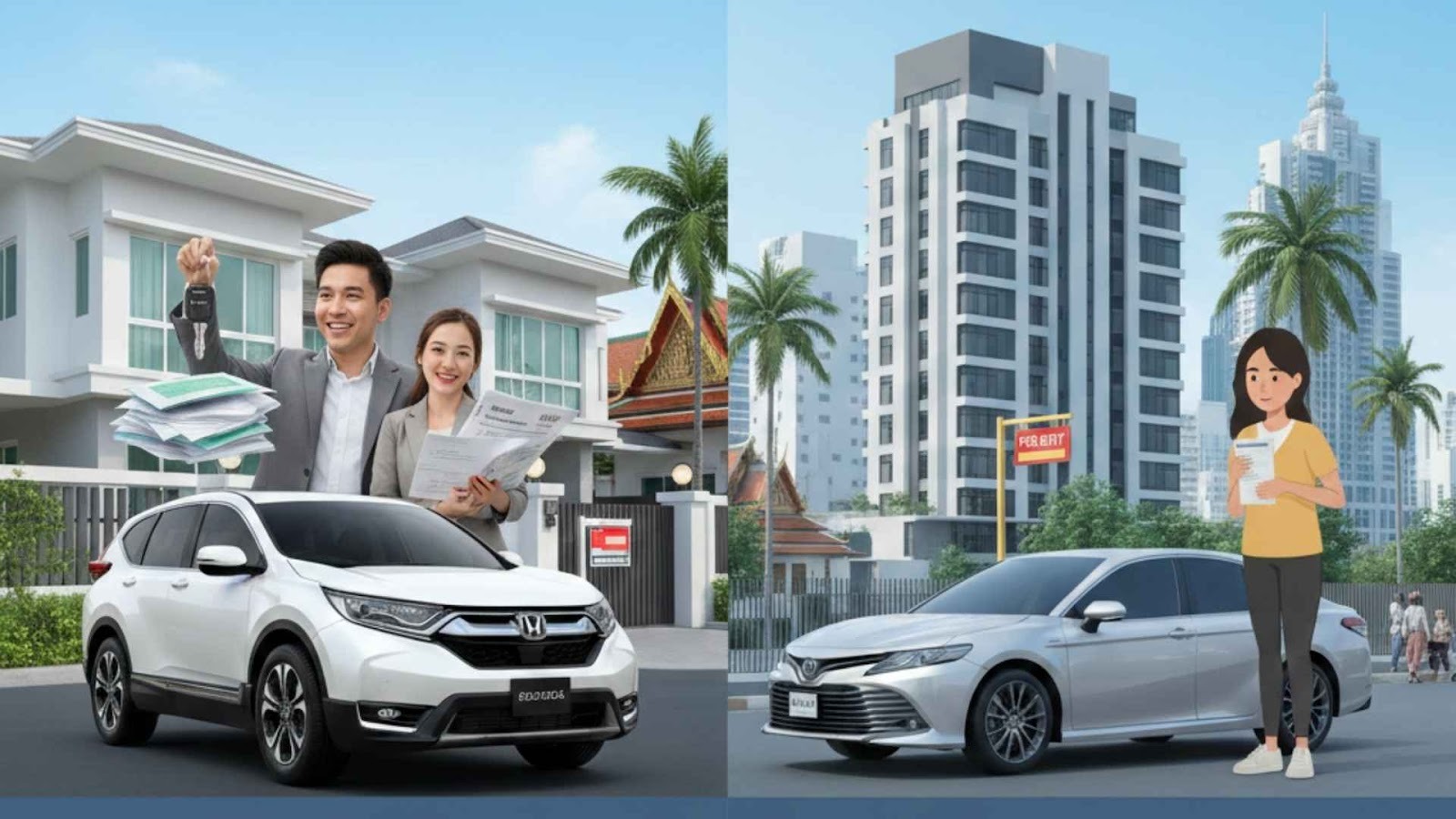
The 2026 Automotive Finance Verdict
The choice between buying (Hire Purchase, HP) and leasing (Operating Lease, OL) in Thailand for 2026 is determined by the applicant's status:
- Corporate Entities: Leasing saves significantly more by maximizing tax deductibility.
- Individual Consumers (EVs/Volatile Market): Leasing is superior for risk mitigation due to unpredictable depreciation.
- Individual Consumers (Long-Term): Buying saves more only for ownership beyond 7 years who can secure low-interest rates.
Key Verdicts
Segment | Financially Superior Option | Key Financial Advantage (5-Year Term) |
|---|---|---|
| Corporate/SME | Operating Lease (OL) | Guaranteed THB 1.16 million in additional tax deductibility for high-value vehicles. |
| Individual (EVs) | Operating Lease (OL) | Transfers unpredictable depreciation risk (a top concern for 42% of EV buyers). |
| Individual (Long-Term) | Hire Purchase (HP) | Allows equity accumulation, but only overcomes high effective interest rates (5.21% - 12.59% p.a.) if kept for 7+ years |
TABLE 1: Direct comparison of structural and cost differences between buying (HP) and leasing (OL).
Core Financial Mechanisms
| Aspect | Buy (Hire Purchase) | Lease (Operating Lease) |
|---|---|---|
| Monthly Cost | Higher (Repays full principal + high interest) | Lower (Up to 40% less; pays only for depreciation) |
| Ownership/Asset | You eventually own the car; it is recorded as a debt/asset | Lessor owns the car; off-balance sheet (rental) |
| Risk Bearer | You assume 100% of maintenance and resale risk | Lessor assumes residual value risk (depreciation) |
| Operational Costs | Variable (You pay separately for insurance, maintenance, road tax) | Fixed, bundled into monthly payment (Full service package) |
TABLE 2 : For passenger cars priced over THB 1,000,000, the Operating Lease is decisively cheaper due to tax law: Tax deductibility comparison for vehicles exceeding THB 1,000,000 purchase price (5-year term)
Key Financial comparison : The Tax & Risk Advantage
A. Corporate Tax Optimization
For passenger cars priced over THB 1,000,000, the Operating Lease is decisively cheaper due to tax law:
- Buying (HP/Cash): Maximum depreciation is capped at THB 1,000,000 over five years .
- Leasing (OL): Monthly lease payments are fully deductible up to THB 36,000 per month . This allows a corporation to claim THB 1.16 million more in deductions over five years compared to buying the same car .
B. Individual Risk Mitigation
The rapid shift to EVs in Thailand means current models face unpredictable resale values. Leasing transfers this risk, guaranteeing the end-of-term residual value, protecting the lessee from sharp market depreciation.
Hidden Costs & Risk Management
Cost Model | Primary Risk | Financial Penalty |
|---|---|---|
| Buying (HP) | Unforeseen maintenance/breakdown costs | Must manage and pay for all unexpected repairs |
| Leasing (OL) | Exceeding mileage limits | Penalty of approximately 2 THB per excess kilometer |
| Buying (HP) | Illiquid asset loss | Depreciation rate typically 10%–15% per year |
| Leasing (OL) | End-of-lease fees | End-of-lease feesCharges for excess wear and tear or damage |
TABLE 3 : Overview of primary risks and potential penalties associated with each financing model.
This section details the primary, non-fixed financial risks inherent in each model. Successfully navigating these risks is often the key determinant of which option saves more money overall.
Risks for the Buyer (Hire Purchase)
The HP buyer assumes full liability for the asset's performance and eventual market value.
- Uncertainty of Maintenance Costs: While routine servicing is predictable (THB 5,000 to THB 15,000 annually) , the buyer is entirely responsible for all unforeseen breakdowns, major component failures, and accident repairs. Over a 5-to-7-year ownership term, these expenses introduce significant financial volatility.
- Depreciation and Resale Risk: The owner absorbs 100% of the depreciation risk. With a standard depreciation rate of 10%–15% per year , this leads to a major loss upon resale. This risk is amplified in the modern Thai market due to rapid technological innovation (especially in the EV sector) and constant price wars, which can further erode resale value unpredictably. The administrative burden and difficulty of managing the private sale or trade-in process also fall solely on the owner.
Risks for the Lessee (Operating Lease)
The lease's convenience comes with strict contractual obligations regarding usage:
- Excess Mileage Penalties: Lease agreements impose rigid annual mileage caps, commonly set between 12,000 and 20,000 kilometers. If the usage exceeds this contractual limit, the lessee is charged a substantial fee for every extra kilometer, typically around 2 THB per excess kilometer in Thailand. Driving significantly over the limit can result in penalties that accumulate to thousands of baht and eliminate the lease's cash flow benefit.
- Excess Wear-and-Tear Fees: Although normal wear and tear is covered, the lessee is financially liable for excess damage caused by neglect, accidents, or misuse. These damages are assessed by independent inspectors at the end of the term, who follow standardized "Fair Wear & Tear" guidelines. Examples of unacceptable damage include large scratches that break the paint surface, dents exceeding acceptable sizes, or interior damage like burns or tears. Failure to adhere to the manufacturer's required maintenance schedule can also result in additional fees.
- Early Termination Penalties: Operating leases are fixed-term contracts (typically 2–5 years).Should personal or business circumstances require an early exit, the contract is legally binding. Terminating a lease before its expiration usually results in substantial early termination fees or penalties, as the lessor must recover the amortized value of the asset.
Frequently Asked Questions (FAQ)
1. What is the estimated overall cost of owning a car per month (excluding the loan/lease payment).
Excluding financing payments, the estimated recurring costs for fuel, insurance, and maintenance generally fall between THB 7,000 and THB 10,000 per month.
2. What is the typical annual depreciation rate for a vehicle in Thailand?
Vehicles typically lose value at a rate of 10% to 15% per year. This can lead to a significant financial loss if you sell the vehicle later.
3. When is buying (Hire Purchase) the better financial choice for an individual?
Buying is generally favored only if you plan to stay in Thailand for five years or more (optimally 7+ years), you secure a highly competitive interest rate, and you value having no restrictions on mileage or customization.
4. : What are the typical effective interest rates for new car loans (Hire Purchase)?
Effective interest rates for new car loans in Thailand typically range from 5.21% to 15.81% per annum. Banks often offer more competitive rates than specialized financing companies for applicants with strong credit.
5. What is the maximum duration for a car loan (HP) term?
Loan contract lengths for Hire Purchase typically range from three to seven years, with terms up to 84 months (seven years) commonly available.
6.What are the tax implications for depreciation when a company buys a car?
When a company purchases a passenger car, tax regulations cap the annual depreciation deduction at THB 200,000 per year, based on a maximum cost of THB 1,000,000. Any cost exceeding this threshold is non-tax deductible.
7. What is the standard contract length for an operating lease?
Operating leases are generally shorter and more flexible than HP, typically lasting 2 to 5 years.
8. What are the typical annual mileage limits in a lease contract?
Most lease agreements impose annual mileage restrictions, commonly set between 12,000 and 20,000 kilometers per year.
9.What is the cost penalty for exceeding the mileage limit?
Excess usage typically incurs a penalty of approximately 2 THB per excess kilometer. Exceeding this limit substantially can quickly erode the cost savings of leasing.
10. What is the maximum tax deduction for a company car under an Operating Lease?
For corporate entities, the rental payments for an operating lease are fully tax-deductible up to THB 36,000 per vehicle per month (or THB 432,000 annually).
Motorist Thailand
Motorist Thailand is a trusted platform that simplifies vehicle transactions and ownership management.
- Transaction Services: Manages all necessary paperwork for buying and selling, including DLT ownership transfer and loan settlements.
- Insurance Optimization: Provides competitive motor insurance quotes within 24 hours, often offering flexible 0% interest-free installment plans for renewals.
- App Features: Offers timely reminders for critical compliance deadlines like road tax and insurance renewal.
Claim your free car valuation today!
Read More: Sell your car for the highest price in 24 hours
Looking for a car appraisal? You can contact us for a free car valuation within 24 hours…